
Can you trademark a smell?
Most trade mark regimes are built around signs that can be seen: words, devices, colours, shapes. Olfactory (smell) marks sit uneasily inside that architecture. They raise two recurring doctrinal problems: (1) how to represent the sign on a public register with enough precision that competitors and examiners know the metes and bounds of protection; and (2) whether the scent functions as a trade mark — a source-identifying sign — rather than as a functional or natural characteristic of the goods.
India’s Trade Marks Registry confronted both questions in Application No. 5860303. On 21 November 2025, the Controller General of Patents, Designs and Trade Marks (CGPDTM) accepted the application for advertisement under section 20 of the Trade Marks Act, 1999, as an olfactory mark — widely reported as India’s first smell mark cleared to advertise. Acceptance for advertisement is a procedural milestone. It is not final registration.
The application
The applicant is Sumitomo Rubber Industries, Ltd. (Kobe, Japan). The mark is described as “FLORAL FRAGRANCE / SMELL REMINISCENT OF ROSES AS APPLIED TO TYRES”, claimed in Class 12 for tyres for vehicles, on a “proposed to be used” basis.
Sumitomo has publicly linked the rose-like fragrance on certain tyres to branding practice dating from around 1995: the scent is presented as a deliberate sensory signature, not as a technical feature for grip or performance. That factual framing matters for the distinctiveness and non-functionality analysis below; it is not itself a holding that the Indian register has finally conferred exclusive rights.
Procedural timeline
- 23 March 2023 — Application 5860303 filed (Delhi).
- 4 August 2023 — Examination report objecting under section 9(1)(a) (lack of distinctiveness) and section 2(1)(zb) (graphical representation / definitional requirements for a “trade mark”).
- 27 September 2023 onward — Applicant response, hearings, and written submissions. Amicus assistance from trade mark counsel Pravin Anand; scientific characterisation developed with researchers at the Indian Institute of Information Technology, Allahabad (IIIT Allahabad).
- 21 November 2025 — CGPDTM order: mark accepted; Registry directed to advertise under section 20 as an olfactory mark together with the graphical representation and description on file.
- 24 November 2025 — Advertisement in Trade Marks Journal No. 2236.
Secondary reporting through early–mid 2026 indicates that oppositions were filed and that the application entered contested proceedings (Intepat status overview). Live status should be verified on the IP India register before any stronger claim. Until registration issues, the accurate description remains accepted for advertisement / under opposition.
Statutory tests in play
Graphical representation — section 2(1)(zb)
India’s Act does not create a closed list that excludes smells. It does require that a trade mark be capable of being represented graphically. For non-visual signs, that requirement does most of the doctrinal work: the register must define what is protected in a form that is durable, objective, and intelligible enough for third parties.
The applicant’s answer was a scientific seven-dimensional olfactory vector prepared with IIIT Allahabad, mapping the rose-like smell across axes commonly summarised as floral, fruity, woody, nutty, pungent, sweet, and minty.
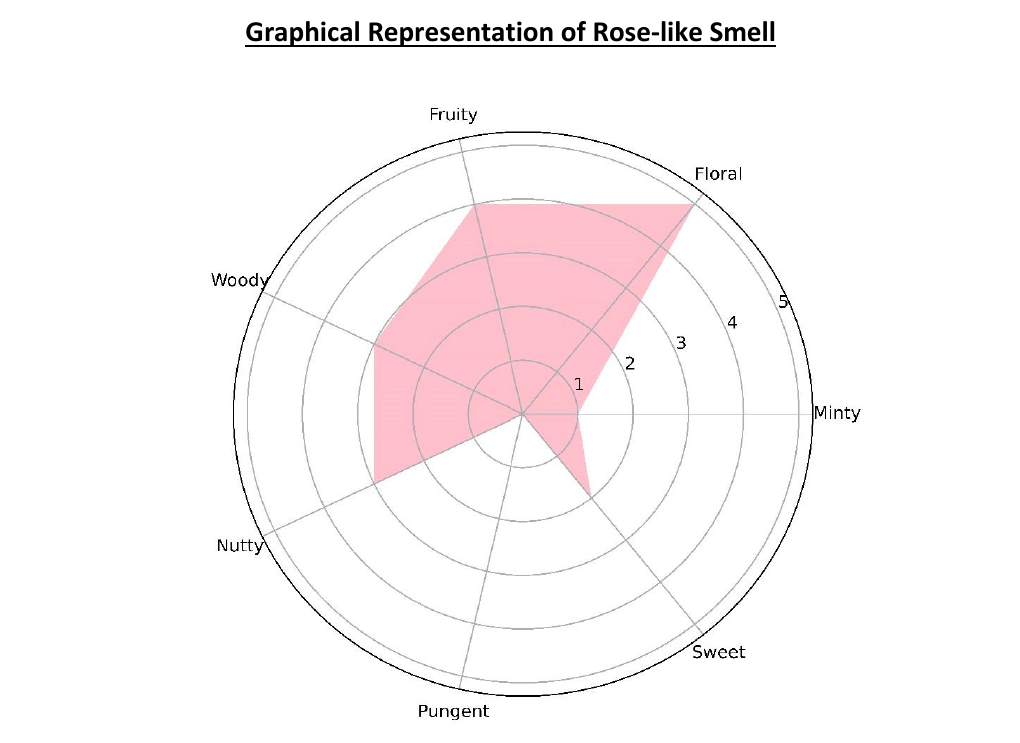
Graphical representation of the rose-like smell as a 7-dimensional olfactory vector (IIIT Allahabad; annexed to the CGPDTM acceptance order for App. 5860303). Commentary on the order (including Chambers’ analysis) treats this vectograph as the pivotal evidentiary move: it converts a subjective sensory experience into a reproducible graphical profile.
The CGPDTM accepted that representation as meeting the Act’s clarity / precision / objectivity expectations for advertisement purposes — language that sits in the same family as Europe’s Sieckmann criteria (clear, precise, self-contained, easily accessible, intelligible, durable, and objective), even though Sieckmann is not Indian binding precedent.
Distinctiveness — section 9(1)(a)
A scent that merely describes or is inherent to the goods will struggle. The Registry’s path to acceptance turned on the claim that a rose fragrance on tyres is arbitrary relative to the ordinary olfactory impression of rubber goods, and that it operates as a source cue rather than as a functional attribute of the product.
That contrast — floral signature versus expected rubber smell — is the classic non-traditional-mark move: the less the scent is a natural or technical feature of the goods, the more plausible it is as a trade mark. Had the claimed “mark” been the ordinary smell of vulcanised rubber, the section 9 analysis would look materially different.
What the order establishes — and what it leaves open
Established (on these facts, at the acceptance stage):
- An olfactory mark can clear examination and be accepted for advertisement in India where the applicant supplies a sufficiently objective graphical representation and a coherent distinctiveness theory.
- Scientific vectorisation (here, the IIIT Allahabad 7D model) is a viable evidentiary method for meeting graphical-representation demands — at least for this application’s rose-on-tyres description.
Left open:
- Acceptance ≠ registration. Section 20 advertisement triggers the opposition window. Registration remains contingent on the outcome of any opposition (and related procedural steps).
- Scope of the graphical-representation precedent. The order accepts a particular vectograph for a particular scent claim. It does not write a general regulation that every future smell application succeeds, or that every alternative representation method (chromatogram, chemical formula alone, deposit of a sample) will suffice.
- Enforceability. No Indian court has yet tested how a registered olfactory mark would be proved, compared, or infringed in contested commercial litigation. Distinctiveness on the register and distinctiveness in the marketplace remain analytically adjacent but not identical.
- Comparative weight of foreign filings. Sumitomo’s earlier UK registration UK00002001416 (1996) — often cited as the UK’s first smell mark for the same rose-tyre concept, and later widely reported as lapsed — was persuasive context, not binding Indian authority (SpicyIP background).
Comparative notes (brief)
Smell marks remain rare globally, and national rules diverge sharply.
- United Kingdom / EU trajectory: Early UK practice permitted limited olfactory registrations (including Sumitomo’s 1996 rose-tyre mark). Post-Sieckmann, graphical-representation standards made scent registration extremely difficult in EU practice; many earlier UK smell marks have not endured on the register.
- United States: A different tradition. In re Clarke (TTAB 1990) allowed a plumeria fragrance for sewing thread/yarn where the scent was non-functional and shown to identify source. Later examples include Hasbro’s registered PLAY-DOH scent (2018). US doctrine emphasises non-functionality and distinctiveness (often acquired), with less insistence on a Sieckmann-style graphical formalism.
- Asia: India’s acceptance is a local doctrinal milestone under the 1999 Act. It does not automatically liberalise olfactory practice in neighbouring offices; each statute’s representation and distinctiveness tests still control.
Technical wrap
App. 5860303 is best read as India’s first serious reconciliation of olfactory branding with the Act’s graphical representation and distinctiveness gates — not as a completed grant of exclusive rights. The CGPDTM order establishes that a scientifically characterised smell can be accepted for advertisement. Whether this mark registers, how far the 7D method generalises, and how olfactory rights would be enforced remain open questions for opposition practice and, eventually, the courts.
Disclaimer: This article is general information on Indian and comparative trade mark doctrine. It is not legal advice. Application status changes; verify the live register and primary order text before relying on any filing.
Sources
- CGPDTM acceptance order (App. 5860303, 21 Nov 2025) (Anand & Anand mirror)
- WIPO Magazine — India's first smell mark: Sumitomo rose-scented tires
- Trade Marks Journal extract — Journal No. 2236 / App. 5860303
- SpicyIP — Sumitomo rose-tyre filing and UK prior context
- Chambers — CGPDTM accepts rose fragrance for tyres
- Chambers — comprehensive analysis of the rose-scented tyre mark
- Intepat — smell trademarks in India (incl. opposition status note)
- IIIT Allahabad — systems biology note on the first smell mark / 7D approach
- In re Clarke (TTAB) — plumeria yarn scent
- Hasbro — PLAY-DOH scent trademark announcement
- IP India — Trade Mark application / status search (enter application number 5860303)